
TDC Industrial
A field-services brand ready for larger projects.
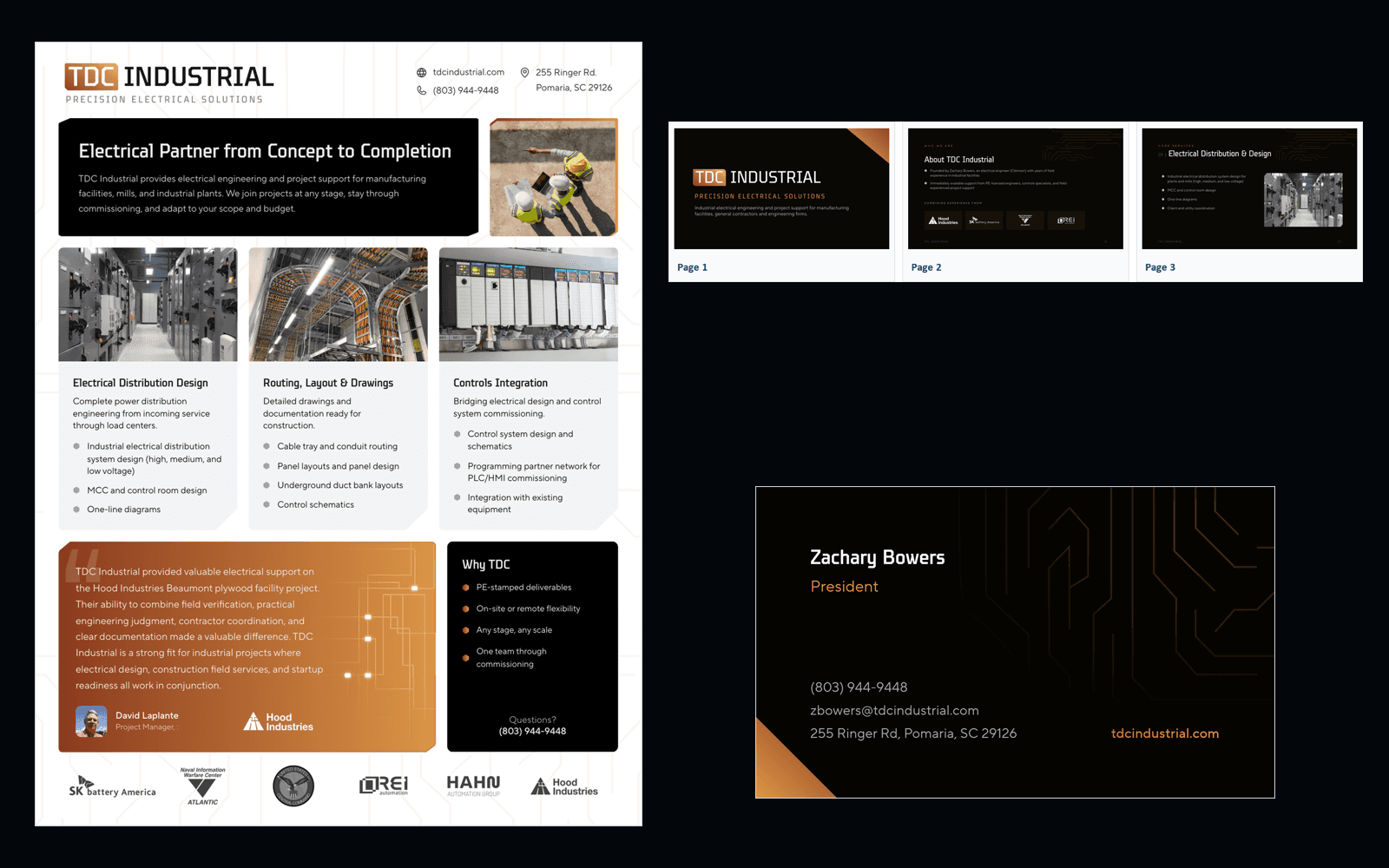
The identity, public site, services flyer, sales deck, business cards, and proposal-facing materials were rebuilt as one system for capital-project buyers.
View the case studyEngineering firms are often judged before a buyer ever meets the technical team. Demand Delta turns your positioning, project experience, and technical approach into a consistent system of proposals, capability statements, presentations, and sales graphics.
Your project experience may be relevant and your team qualified, but buyers can only evaluate what the materials make clear. Inconsistent proposals, generic capability statements, and dense technical diagrams force them to work too hard to understand why your firm fits.
Bid-ready assets turn your positioning, project experience, and technical approach into a reusable system. Seller-doers can tailor the message to each pursuit without rebuilding the design or starting from an old file.
What buyers should understand quickly
The goal is not decoration. It is to make your qualifications easier to evaluate and easier to remember.
Work examples
Brand strategy creates more value when it is carried into the materials used to win work. The same positioning, visual language, and proof should appear across capability statements, proposals, presentations, technical diagrams, and follow-up.
TDC Industrial
The identity, public site, services flyer, sales deck, business cards, and proposal-facing materials were rebuilt as one system for capital-project buyers.
View the case studyRillstone Water Engineering
Logo, typography, color, messaging, project profiles, and everyday company applications use the same visual rules instead of drifting by document or department.
Rillstone Water Engineering
Qualifications, proposal covers, project sheets, resumes, and technical approach pages share a repeatable structure while leaving room for pursuit-specific content.
Rillstone Water Engineering is a fictitious demonstration company. TDC Industrial is client work shown with permission.
Not every firm needs every deliverable. The scope should focus on where buyers lose clarity, where seller-doers waste time, and which materials are reused across the most opportunities.
Positioning, logo, typography, color, imagery, and messaging rules when the firm's materials no longer reflect the quality or direction of the business.
Capability statements, proposal templates, project sheets, resumes, and presentation decks when pursuits depend on repeatedly rebuilding old files.
Process diagrams, system maps, equipment visuals, and 3D animation when buyers need to understand a complex approach quickly.
Review target buyers, differentiators, current materials, and recent pursuits to identify what buyers need to understand and where the current system creates confusion.
Develop the messaging and visual direction around real buyer priorities, the firm's competitive context, and the reasons its experience is relevant.
Use actual company content to create the priority proposals, capability statements, presentations, and graphics. Refine the strategy when real applications reveal gaps.
Deliver editable templates, production-ready exports, source files, practical standards, and training so the team can keep materials current without depending on a designer for every update.
Starting engagement
$8,000
one-time
A fixed-scope engagement for firms that need their brand and core pursuit materials rebuilt together. It aligns positioning, visual identity, and reusable templates around how the firm wins work.
Typical timeline: 4 to 6 weeks
Included
Learn what other engineering firms are doing to improve proposals, presentations, and technical sales materials.

