Internal Software & AI Automation

Make every engineering hour go further.

Custom software and AI automation remove repetitive work, accelerate critical workflows, and improve the consistency and quality of every deliverable.

Book a Demo

Not every automation idea should become software.

Your engineers already know which handoffs are slow, which documents are repeatedly rebuilt, and where information gets trapped between systems. They can usually describe exactly what they want an automation to do.

The harder question is whether the time saved, risk reduced, or revenue protected will justify the cost of building and maintaining it. Demand Delta evaluates the workflow, technical complexity, reliability requirements, and expected value before recommending a build.

Where the ROI case is strongest

  • Repeated work consumes expensive technical time
  • Delays or errors affect revenue, margin, or project delivery
  • The workflow happens often enough to recover the cost of the tool

Our work with engineering firms has taught us how to distinguish an automation that creates operating leverage from one that becomes another system to maintain. If the ROI case is weak, we will say so before you invest in a build. Our success is measured by the ROI we define with you before the build and track throughout the engagement.

See where internal software is creating leverage for engineering firms.

Demand Delta will show you which workflows firms are automating to reduce overhead, improve quality, and increase delivery speed, then help you identify where the ROI case is strongest in your firm.

Book a Demo

Common applications

Common needs that can justify custom software.

Engineering firms often have a strong ROI case in recurring, document-heavy workflows: assembling pursuits, producing technical deliverables, and finding verified firm knowledge. Each opportunity is evaluated against its frequency, cost, and expected return before a build is recommended.

01

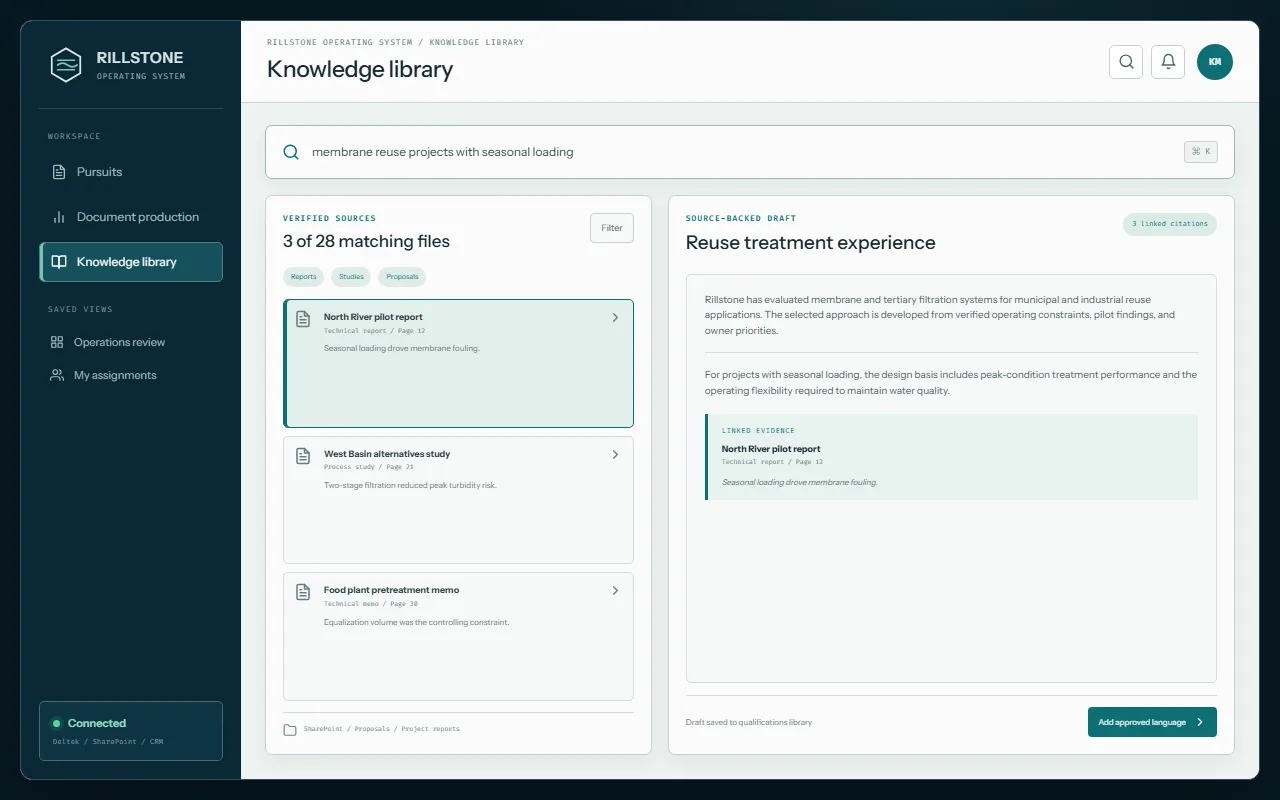
Technical document intelligence

Go beyond generic Copilot search with a knowledge system built around your firm’s technical language, document structure, and workflows. Employees can find answers across reports, studies, proposals, and project files in one fast and accurate interface.

Strongest ROI when new engineers and other employees cannot find useful examples without repeatedly asking experienced staff where information lives.
02

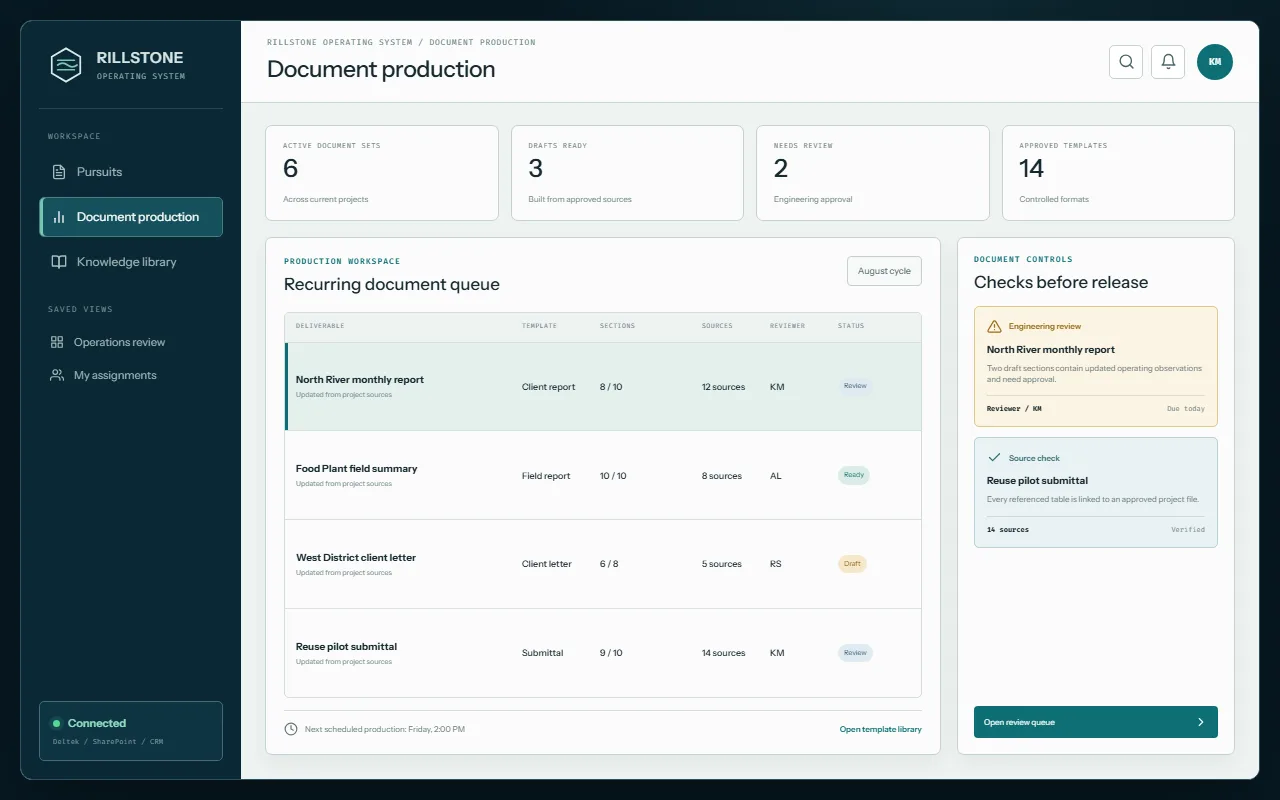
Recurring technical document production

Automate recurring reports, letters, submittals, and other technical deliverables using approved project data and source files. Reusable sections are assembled consistently, variable content retains source traceability, and an engineer approves the final output.

Strongest ROI when teams repeatedly rebuild the same document type and manually move information between files or systems.

03

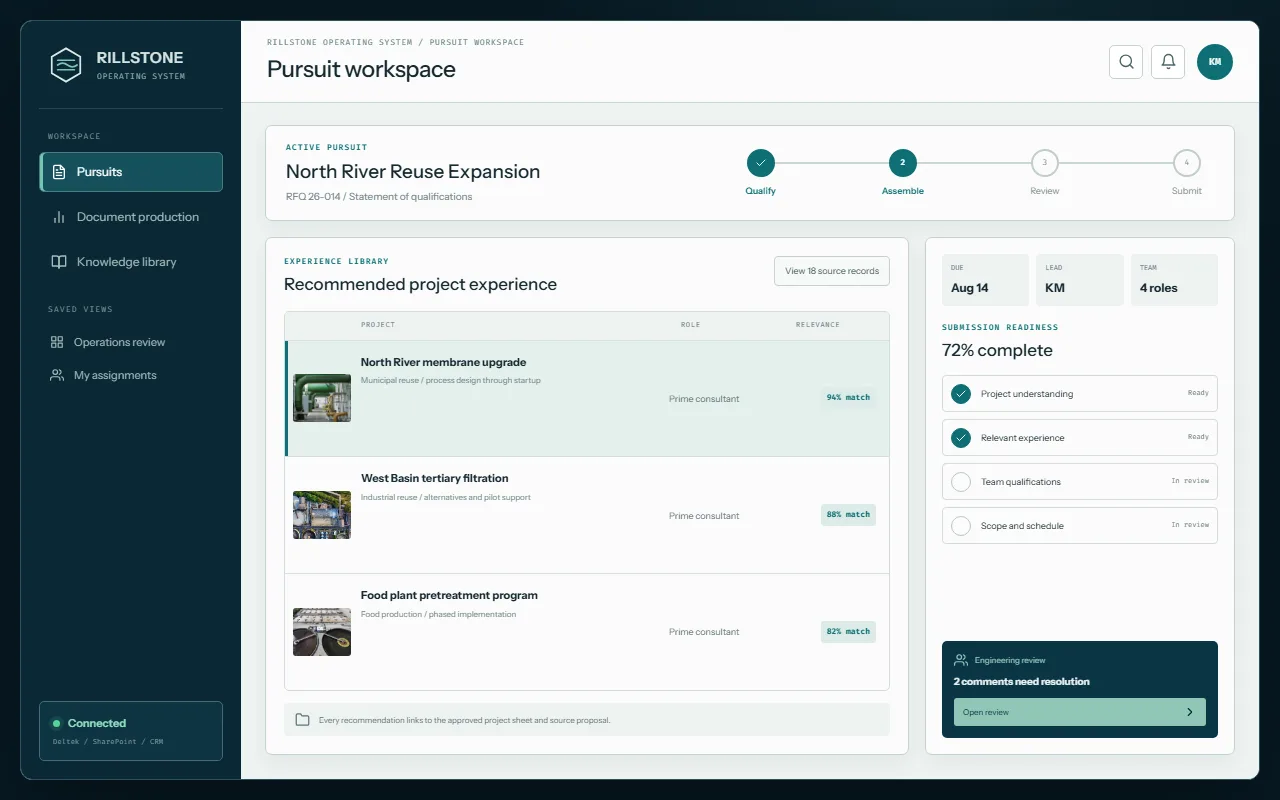
Pursuit and proposal workspace

Move from go or no-go through experience selection, team assembly, scope drafting, and engineering review in one workspace. Every recommendation stays connected to its source record.

Strongest ROI when seller-doers repeatedly rebuild submissions from scattered project sheets, resumes, and old proposals.

Rillstone Water Engineering is a fictitious demonstration company. The workflows are representative examples of common client work.

Own the software, not another per-seat subscription.

Book a Demo

Off-the-shelf software becomes more expensive as you add users, workflows, and features. With a custom tool, your firm owns the application and can share its workflows across the organization without paying Demand Delta per user or feature.

After launch, you pay for the infrastructure, model usage, integrations, and maintenance the software actually requires. You can retain Demand Delta for support as needed or manage the system with your own team.

AI is one part of the system, not the whole answer.

Reliable internal software usually combines rules, integrations, interfaces, and carefully bounded AI. We choose the simplest approach that can produce the required result and support the ROI case.

Workflow automation

Use rules-based logic for repeatable steps, data movement, document assembly, notifications, and approvals that should behave consistently every time.

Applied AI

Use LLMs for search, extraction, classification, and drafting when the work depends on unstructured information. Add source traceability and human review where accuracy matters.

Internal software and integrations

Give the workflow a usable interface and connect the systems that already hold the firm's data instead of forcing employees to move information manually.

Prove the workflow and the ROI before committing to a full build.

The engagement starts with the smallest useful test. Each stage has a decision point, so a weak case can stop before it becomes an expensive software project.

01
Evaluate

Define the case for automation

Map the workflow, people, systems, frequency, and current cost. Establish a baseline and estimate the expected value, complexity, operating cost, and risk.

02
Prove

Test the smallest useful version

Build a realistic working proof using the firm's data and terminology. The people performing the work test it before major architecture and integration decisions are committed.

03
Build

Implement the approved system

Develop the workflow, integrations, permissions, and AI features in reviewable milestones after the solution and ROI case have been validated.

04
Measure

Launch, track, and transfer

Deploy the tool, train the team, document the system, and compare results against the defined ROI. Your firm receives the source code and operating knowledge, with Demand Delta available for support as needed.

See how engineering firms are applying internal software and AI automation.

We will walk through common applications for reducing overhead, improving quality, and increasing delivery speed, then help you identify which opportunities could produce a strong ROI inside your firm.

Book a Demo